×
![Modal Image]()

BriefingAM started from a straightforward product problem: people already had more information than they could use.
News, email, calendars, team messages, podcasts, social feeds, and notifications were all competing for attention. The opportunity was not to create another feed. It was to reduce that information into something more useful: a personalized briefing that identified what mattered to each user and delivered it in text or audio.
Amplified built and operated BriefingAM as a production product, not an internal prototype. The system brought together content ingestion, summarization, ranking, personalization, audio generation, subscriptions, and daily delivery in one consumer experience. Users downloaded the app, completed onboarding, started trials, subscribed, and responded to pricing experiments.
BriefingAM was never intended to compete as another news app. The value proposition was almost the opposite: consume less, understand more.
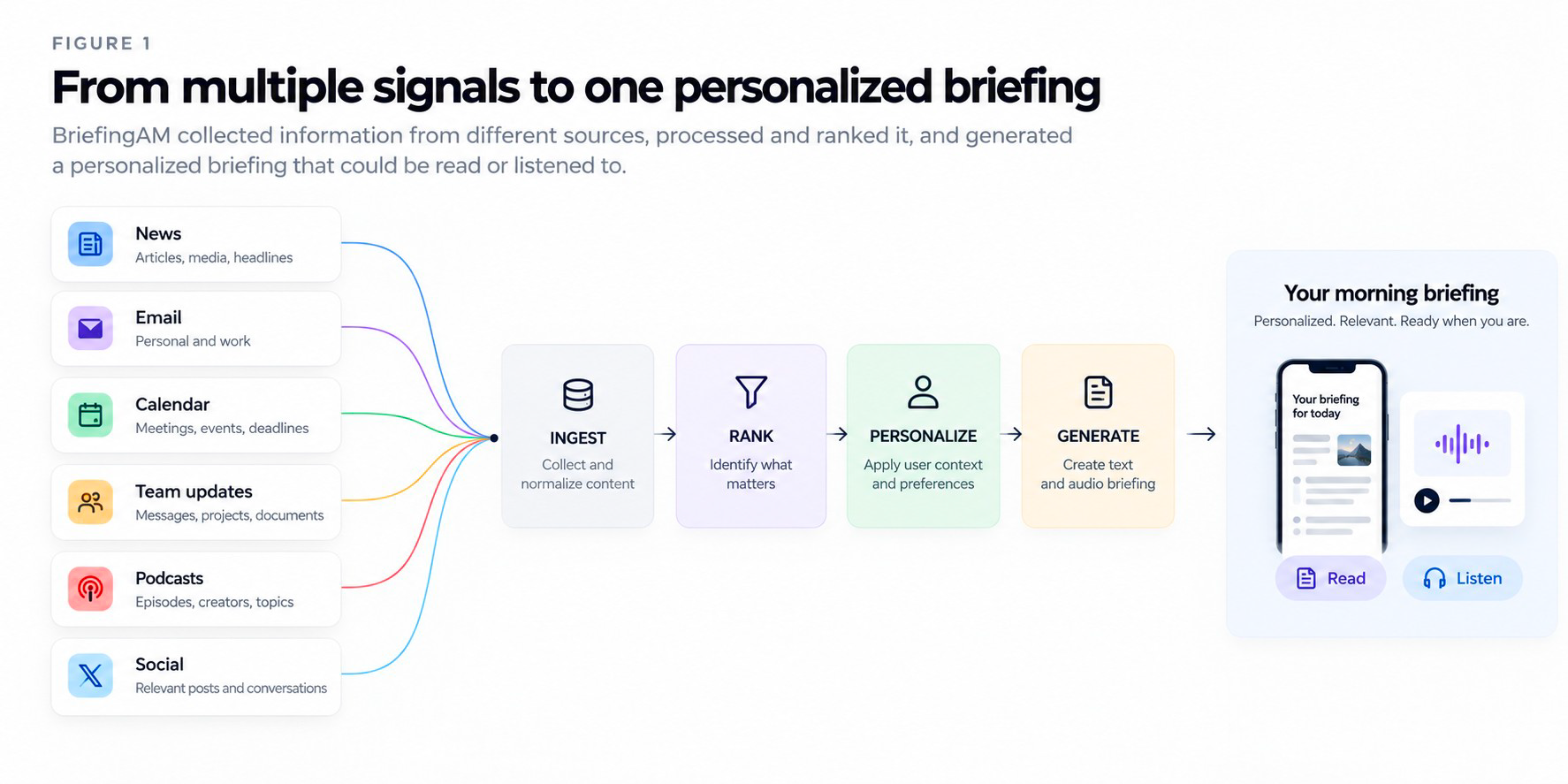
The product collected information from multiple sources, processed and ranked it, generated summaries, personalized the output, and delivered the result as a morning briefing that could be read or listened to.
Summarization was only one part of that system. As AI-generated summaries became easier to produce, the differentiated value moved toward relevance: deciding which information belonged in a particular user's briefing.
A briefing could be technically accurate and still fail if it surfaced the wrong information. A good summary of an irrelevant story was still irrelevant.
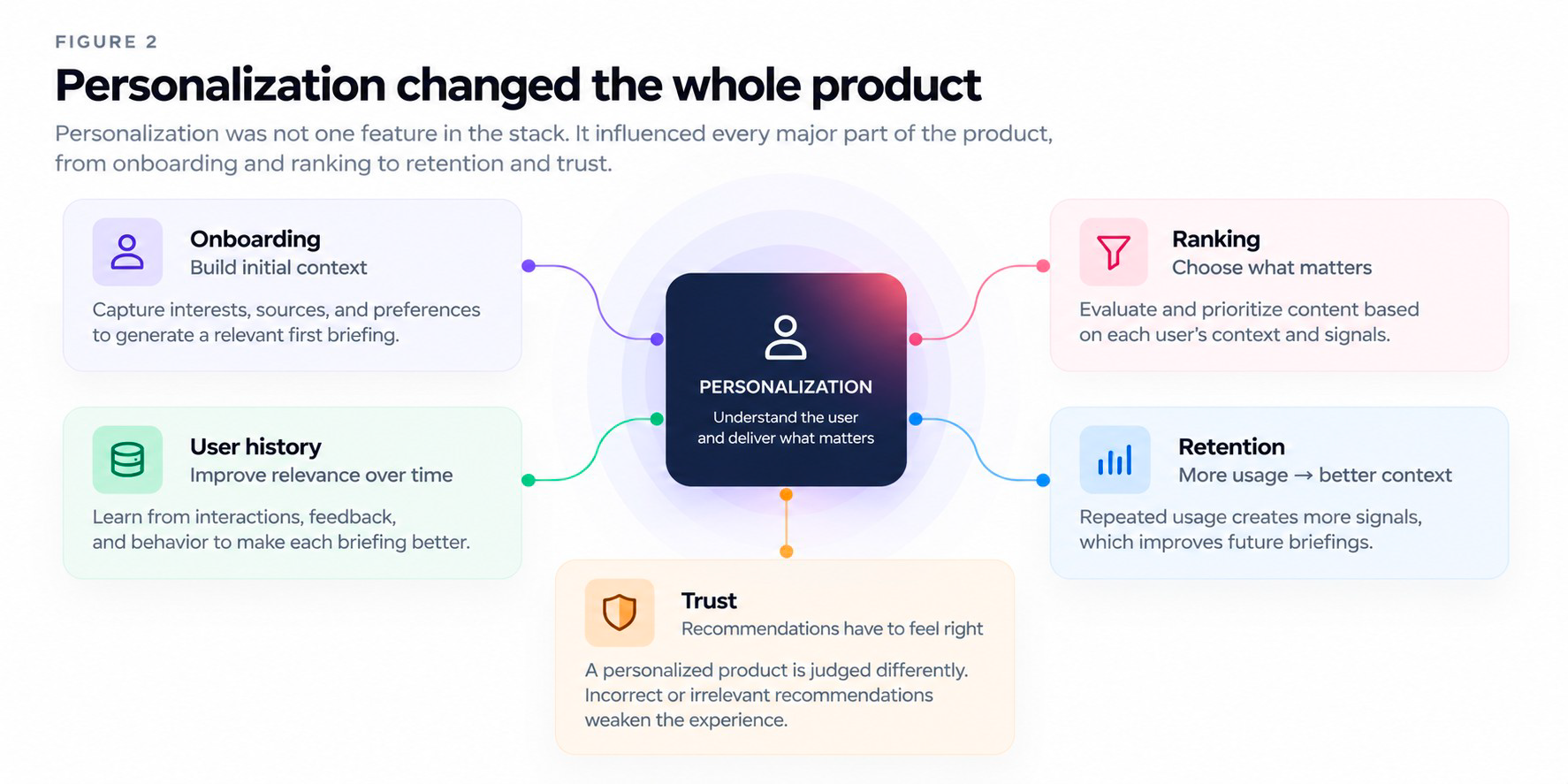
We initially treated personalization as one capability among several. It became the foundation underneath the rest of the product.
Better personalization affected onboarding because the system needed useful context early. It affected ranking because relevance had to be evaluated for an individual user rather than against a generic information hierarchy. It affected retention because repeated usage created more context for future briefings. And it affected trust because a product claiming to understand someone is judged differently from one delivering the same experience to everyone.
A personalized product creates a higher bar for relevance. Incorrect recommendations are not simply content misses; they weaken the system's claim that it understands the user.
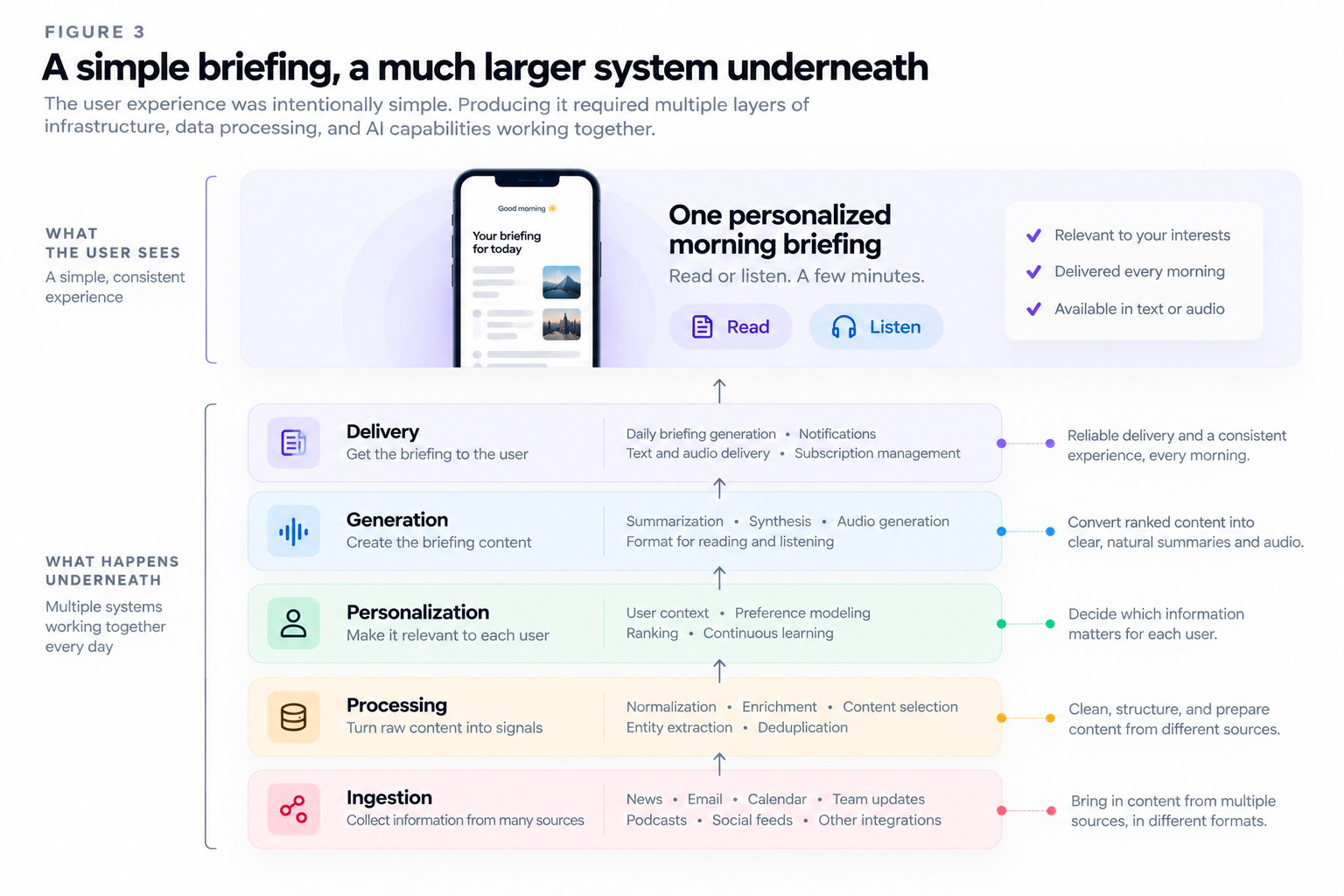
The user-facing interaction was intentionally simple: open the app, read or listen to the briefing, move on with the day.
Producing that experience required much more underneath it. Content had to be collected from different sources, normalized, processed, ranked, summarized, personalized, converted into audio, and delivered consistently. The product also had to manage user context, subscriptions, onboarding, and the daily delivery cycle.
Each layer depended on the others. Better personalization requires more context. More context increased processing and storage requirements. Richer audio introduced another generation and delivery layer. More sources increased the ingestion surface and the number of failure modes the product had to handle.
BriefingAM expanded beyond the first version. News was only one part of the morning. Work updates, local information, recommendations, richer audio, deeper context, and additional integrations could all improve the briefing.
Each addition made sense independently. Together, they changed the product architecture. More sources meant more ingestion paths. More context meant more data to rank and process. Richer personalization increased dependency on user history. More output formats increased delivery and reliability requirements.
The product became more capable, but the operational surface grew with it.
Feature growth in an AI-native product is not necessarily additive. A feature can introduce new infrastructure, dependencies, model usage, failure cases, product states, and maintenance requirements that remain long after the implementation itself is complete.
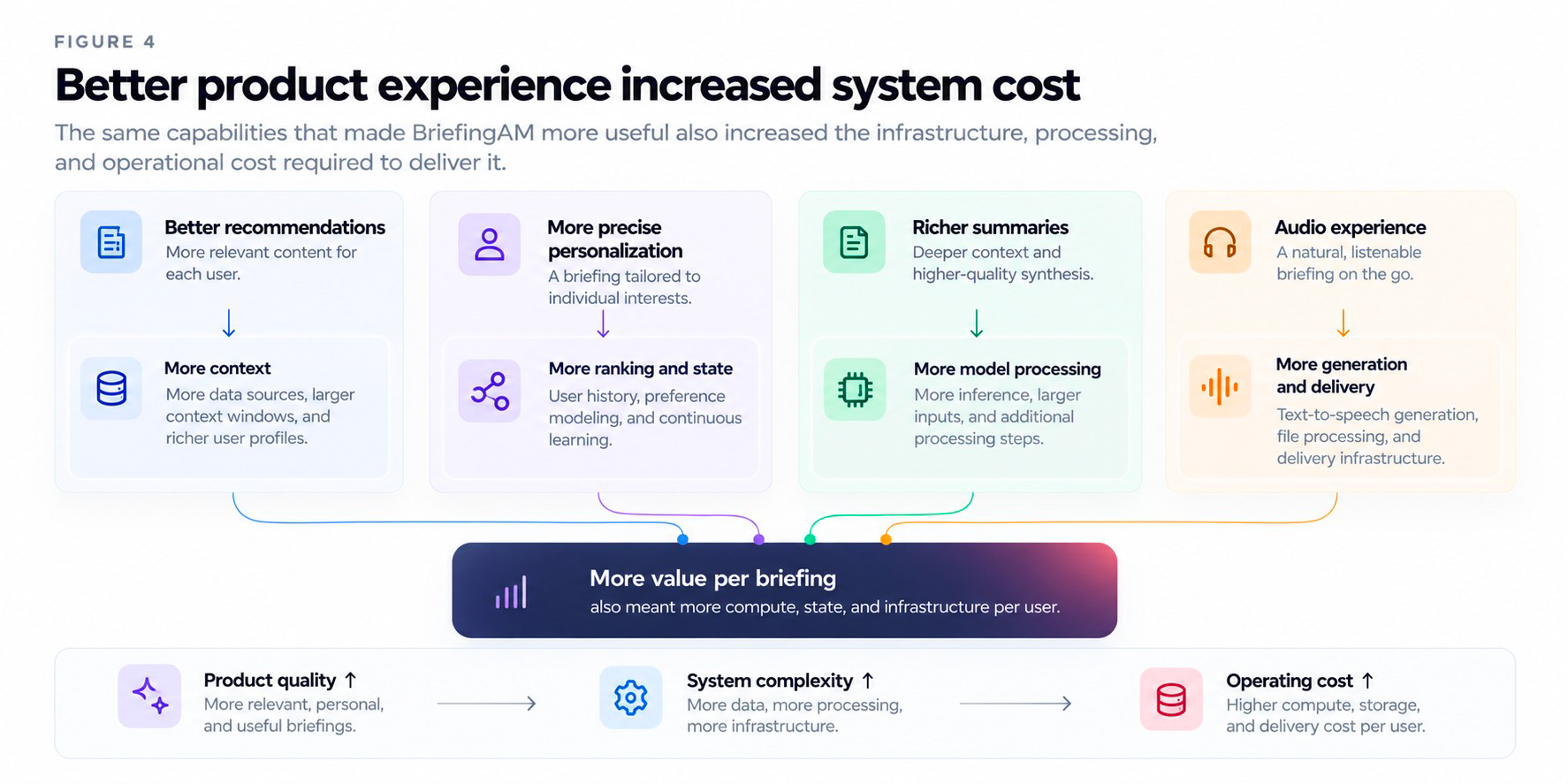
The same capabilities that improved BriefingAM also increased the cost of operating it.
Better recommendations required more context. Better summaries required more processing. Audio introduced its own generation and delivery infrastructure. More sophisticated personalization added complexity across the system.
That creates a different economic profile from much of traditional software. Traditional SaaS products can often spread relatively fixed infrastructure costs across a growing user base. AI-native products may behave differently when better output requires more inference, more context, more storage, or more generation per user.
For BriefingAM, many of the capabilities users valued most were also the capabilities that put the most pressure on operating economics.
A technically better experience was not automatically a better product decision if every improvement also increased the marginal cost of delivering that experience.
Engineering the product was only part of the challenge. BriefingAM was competing with routines that already worked.
People already checked email, scanned headlines, reviewed calendars, listened to podcasts, and used social feeds. A morning briefing had to earn a place inside those existing behaviors.
That made immediacy especially important. One early product decision made the problem visible: the natural experience was for a new user to receive their first fully personalized briefing the following morning.
For a consumer product, every step between discovery and value creates another opportunity for the user not to return.
BriefingAM had users, paying subscribers, and evidence that the underlying problem was real.
But continuing to improve the product meant addressing several structural problems at the same time. Personalization needed to become more accurate while becoming cheaper to deliver. Retention needed to improve. The product surface needed tighter focus. And the architecture underneath personalization, context, and delivery needed to evolve with it.
At that point, the next version was no longer a set of incremental improvements around the existing product. It required a materially different product shape and operating model.
We chose to stop rather than continue optimizing around those constraints. That decision was itself part of the product work: recognizing when the evidence points toward a structural change rather than another iteration.
BriefingAM gave Amplified first-hand experience building and operating an AI-native consumer product across ingestion, ranking, personalization, generation, audio, subscriptions, retention, and production delivery.
More importantly, it changed how we think about the systems around AI.
The quality of the model, the architecture required to deliver its output, the behavior the product needs to create, and the economics of operating it are not separate problems. They reinforce one another.
Better personalization can require more context. More context can increase processing. More processing can change the unit economics. Higher operating costs can change which product experiences are sustainable at scale.
That is why an AI product cannot be evaluated only by what the model can do. It has to be evaluated as a system.